Saturday, 14 January 2017
4 Hour Film Challenge
I used an instrumental cover of wRoNg by ZAYN. The brief was to cut footage to music. The footage used was found on the internet or files I already had saved; I edited it all together to match the beats in the music which will be helpful when editing the music video in the later unit.

Friday, 16 December 2016
The Male Gaze in Chicago
The Male Gaze, is the idea that the female character(s) are purely in the scene as an erotic object for the male characters and male audience. They're are there to be looked at, that is their meaning in the scene/film.
The Cell Block Tango scene from Chicago is a prime example of the male gaze in film. In the scene the girls are dancing around in lingerie in Tango style, a style seen as being sensual, passionate and intimate. The male gaze is prominent throughout this scene, and this is shown by the intense focus on the female body and the way it moves during the tango style dance routine and the close ups on the dancers' legs; also the costumes used in the scene also scream male gaze as they're all dressed in lingerie and heel showing off their physique of the girls, making them an erotic object to the male viewer.
The types of shots used in this scene show the camera as a male with desires towards the women; the long shots show the whole body of the females with them dancing around in the lingerie style costumes which strongly implies the desires towards the females that, in Mulvey's theory, are only a part of the scene to be erotic objects for characters in the scene and the audience.
The close ups do a similar thing, but instead they set the focus in a particular area, for example theres a close up shot on one of the dancers crotch with while rising one foot through the instep drawing all attention to her crotch defining her as a erotic object for males either in the film or in the audience.
The lighting also helps apply Mulvey's theory, the shot when the spotlight hits on the couple doing the spread eagle lift on the drum beat causes your eyes to be drawn to that movement, for Mulvey that would be what a heterosexual male would do in that given situation.
Freud's Theory of the 'Self' in Fight Club
The first scene, I believe, displays Tyler Durden as the id really well. While the Narrator is sat reading the article of the organ Tyler is riding round the house in a very childlike manner. The way Tyler throws himself off the bike at the end of the scene shows the lack of concern for the consequences of actions, although it is only a small consequence of a possible bruise it could be used a metaphor for the bigger decisions Tyler makes with bigger consequences, like Project Mayhem later in the film. Tyler survives solely off desires and wants, and doesn't live in reality he lives in the ideal world where living off desires doesn't end horribly.
The Second scene where the Narrator is always in shot but Tyler and Marla are coming in and out of shot but never together shows the 3 parts working at the same time. It starts with Tyler saying "Tell 'em you blew it all up" straight away shows him as the id as its a very irrational thing to suggest which is a characteristic of the id, being irrational and childish. The childish side comes through further into the clip as well when he tells the Narrator to get rid of Marla when he's done with her rather than doing it himself, much like when a child gets other people to do things for them when they'd rather be doing something else.
To counteract Tyler as the id, Marla takes the part of the superego. This is shown by her very rational and grounded way of thinking. She is the opposite to Tyler Durden and tries to get the Narrator round to her way of thinking, to make him more in touch with the world around him rather than Tyler's made up ideal world where the outcomes of situations don't matter if the action is what you want to do.
Wednesday, 14 December 2016
Shot Types for Psychoanalytical Film

I would like for my film to start with mirror shot of the main character, in the way her parents want to see her, put together and neat. I feel like a mirror shot is good start to my film as the idea of starting with a reflection being what is seen first gives the impression that what you first see isn't what is true; which later becomes known as the 'her' that her parents know isn't who she really wants to be. She feels trapped in the reflection of her parents ideals.

I plan to used long and extreme long shots to show the isolation the main character is feeling at the point in the film where she is still trying to fill the void although she is drinking and smoking, what she expected to fill the void and make her feel whole.
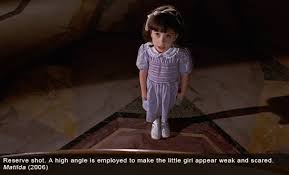
The high angle would be used in parts of the film in which the main character is under the control of her parents. The use of the high angle would show that the main character is inferior in the situation and not in control of her own life; instead she is controlled by her authoritative parents.



Close ups gives a closer look into the emotions of the character in frame which is vital to my concept. The girl who is central in my film is a very emotional teenage girl, so I feel that close ups will capture the level of emotion I need to portray the character to the extent I would like.
Tuesday, 13 December 2016
Psychoanalytical Film Idea
Lacan 'lack' Theory
My idea is a young girl who is living under the control of super authoritative parents with very strict rules and expectations. From watching TV and on social media the girl believes she is missing out on a regular life. She starts to act out against her parents' wishes, begins to drink and sneak out in order to live the life she thinks she's missing out on.
As the film progresses her problems get worse and goes from small issues (sneaking out and occasional drink) to excessive drinking and sleeping around to rebel against her parents; to the point of no return.
The 'lack' missing from my main character's life is the 'typical' teenage life that in reality doesn't actually exist, which is why the more she drinks and acts out she still feels the need to carry on because she's trying to live up to the expectations set by the media and the lives portrayed are unattainable in real life. Yet she continues to reach out for what she can never have.
Freud 'self' Theory
As well as Lacan's 'lack' my film will also demonstrate Freud's theory of the 3 parts of the self.
The parents act as the superego
The main character is the ego
The TV show (Skins) represents the id
Visual Mood Board

Monday, 12 December 2016
Lacan's Theory in Fight Club
Lacan's theory suggests that during our early years, between 6 to 18 months old, in which our younger selves see our reflection as a perfect being and from then constantly try to achieve the perfection that is 'lacking'.

A nameless first person narrator (Edward
Norton) attends support groups in attempt to subdue his emotional state and
relieve his insomniac state. When he meets Marla (Helena Bonham Carter) another
fake attendee of support groups, his life seems to become a little more
bearable. However when he associates himself with Tyler (Brad Pitt) he is
dragged into an underground fight club and soap making scheme. Together the two
men spiral out of control and engage in competitive rivalry for love and power.
When the narrator is exposed to the hidden agenda of Tyler's fight club, he
must accept the awful truth that Tyler may not be who he says he is.
Fight
Club shows how easy it is for people to become so engrossed in ‘bettering their
lives’ that it leads to destruction of some sort. The Narrator feels he is
living an empty live with no personal identity or purpose where was Tyler
Durden is living a full life with the soap business and a lot of personality. The
Narrator feels as though something in his life is missing so tries many
different things to try and fill the gap from buying all the new furniture from
the Ikea catalogue so that he can feel like his life is the way it should be,
but when that doesn’t help he buys something new until his condo looks like the
Ikea catalogue itself. During this scene text flashes up onscreen in the font
and format used in an Ikea catalogue. The text takes up the majority of the
screen showing that it’s taking up the majority of the Narrator’s life because
he’s trying to make his life the perfect life he sees in the catalogue.

As
well as the catalogue lifestyle he starts to attend self-help groups for the
terminally ill/dying in attempt to fill the void he’s feeling. He goes to the
self-help groups to make himself feel better by being surrounded by people who
really have it worse than him, like Bob, Bob has lost his testicles due to
cancer and because of the hormone imbalance in his body he grew breasts, he’s
lost part of what makes him a man and gained a womanly asset; his life is a lot
worse than what we know of the Narrator’s. When he realises that the groups
aren’t working he moves onto the next thing because they aren’t giving him what
he wanted. The next thing being his condo blowing up losing his ‘perfect Ikea’
lifestyle leading him to meet Tyler and fight
club beginning. The fight club is
giving the Narrator the fix of adrenaline and filling the space he thinks he
needs only later for not to be enough kick starting project mayhem, all with the help of Tyler and him being the front
man of both fight club and project mayhem. As project mayhem unfolds it loops back to the first scene of the film
which gives the audience the impression that after everything the Narrator goes
through to find what he thinks to be missing none of it was enough for him and
he’s going to start all over again until he finds what wants to fulfill the
void. Adding
the character of Tyler Durden adds depth and dimension to the situation of the
Narrator trying to find what he wants as it shows him as chasing what he sees
as the perfect lifestyle for him, which is Tyler’s life. Using Freud’s theory
of the self and seeing Tyler as just an aspect of the Narrator’s self shows
that the Narrator is chasing a life of someone he thinks to have what he wants
when in reality its himself he’s trying to be, just what his mind sees as the
‘perfect’ him.
Subscribe to:
Posts (Atom)
-
I found promotional videos for different dance schools to see what seems to be popular for when I make my promotional video for Kel...
-
I started this unit by researching music video theories (Andrew Goodwin and Carol Vernallis) and analysing 4 music videos of my choice. Th...
-
Jacques Lacan was a major figure in twentieth century Parisian intellectual life and often referred to as "The French Freud". He...
